Last checked:
Your well system explained
If your water comes from a private well, you own a small water system: a well, a pump, a pressure tank and controls, maybe some treatment equipment, and the job of testing the water. This guide walks through each part in simple terms: what it does, signs it needs attention, how long it typically lasts (only where a published source says so), routine upkeep, and who to call. For more detail on how wells are built, see how a private well works.
Knowing your system can't tell you whether your water is safe to drink. Only a test by a state-certified lab can show what's in it. Repairs to the well, pump and electrical parts are jobs for a licensed professional where your state requires one.
- The whole system at a glance
- 1. The well: drilled, dug or driven
- 2. Casing and well cap
- 3. The pump: submersible or jet
- 4. Pitless adapter
- 5. Pressure tank
- 6. Pressure switch
- 7. Pressure gauge
- 8. Treatment equipment (if you have any)
- 9. The water test
- Homeowner checklist
- Where to get tested and treatment options
- Related guides
The whole system at a glance
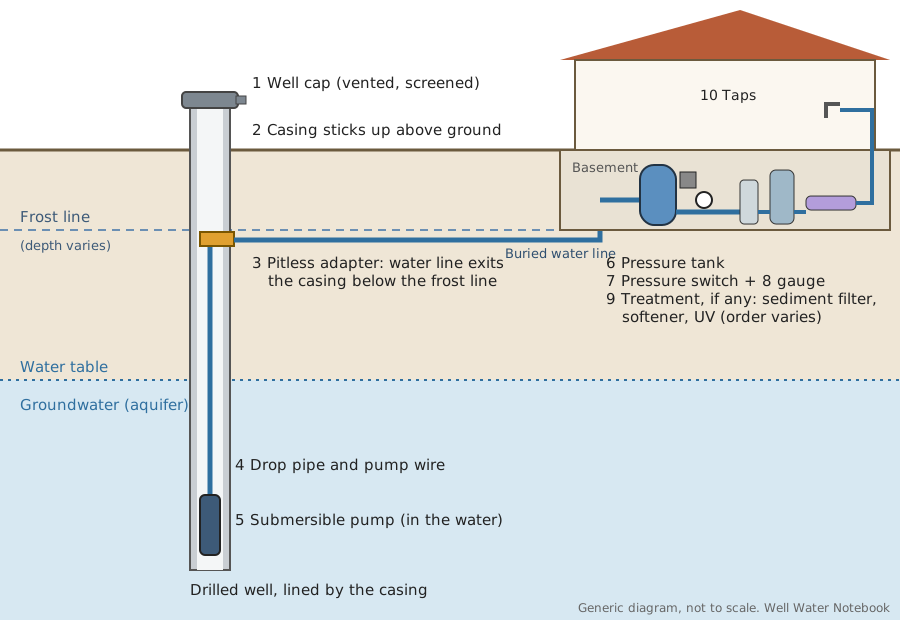
Water moves through the numbered parts in order: from the aquifer into the well, up through the pump and drop pipe, out the side of the casing at the pitless adapter, through the buried line into the house, into the pressure tank, through any treatment, and out to your taps. The most common household setup is a drilled well with a submersible pump and a pressure tank.5
1. The well: drilled, dug or driven
What it is. EPA describes three types: dug or bored wells (dug by shovel or backhoe, about 10–30 feet deep, not continuously cased), driven wells (pipe driven into the ground, about 30–50 feet), and drilled wells (made with a drilling machine, can be thousands of feet deep, and must have casing).1 More on the differences is in how a private well works.
Signs of trouble. NGWA lists these as reasons to get the well checked without waiting for an annual visit: changes in the water's taste, odor or appearance; less water, or pressure that drops and surges; a positive bacteria test; any time the well has been opened; and visible damage at the wellhead or signs of flooding.2
How long it lasts. NGWA says most residential wells are designed to last 20 or more years, depending on construction, geology, water quality and upkeep.2 University of Nebraska Extension says a well's life span varies greatly but is usually about 50 years, and that minerals can clog the screen and pump.5 Minnesota's health department says a life of 25 to 50 years is more common, though some wells last 100 years or more.6
Who to call. A licensed well driller or well contractor. Find one in our directory of licensed well pros.
2. Casing and well cap
What they do. The casing is the pipe that keeps the hole open and, with grout around it, keeps out dirt, surface water and lower-quality groundwater. The well cap sits on top to keep out debris, insects and small animals, and has a vent.1
Signs of trouble. A cracked or loose cap, a missing or torn vent screen, a loose casing, a gap between the casing and the soil, or ground that slopes toward the well so water can pond around it.52
Upkeep you can do. NGWA suggests checking that the casing sticks up at least 12 inches above the ground, that the cap is secure with its seals intact, that the ground slopes away from the casing, and that paint, fertilizer, pesticides and motor oil aren't stored near the well.2 New York's health department says to inspect the casing, cap and area around the well at least once a year.7
Who to call. A licensed well contractor. NGWA says a professional should inspect and re-seal the well any time the cap or seal is removed.2
3. The pump: submersible or jet
What it does. Lifts water out of the well. EPA says submersible pumps (down inside the casing) are the most common for deep wells, and jet pumps (above ground, using suction) are the most common for shallow wells of 25 feet or less.1 A check valve keeps water from flowing back down the well.8
Signs of trouble. University of Nebraska Extension describes three:5
- No water at all. First check whether the house has power and whether the pump's breaker has tripped. If that's not it, call a licensed professional.
- The pump runs nonstop. A check valve may be stuck open, or there may be a leak in the line to the house or in the plumbing. A soggy spot in the yard (away from the septic field) can point to a broken line.
- The pump runs only a few seconds, then shuts off. That usually means there isn't enough air in the pressure tank (see below).
How long it lasts. None of our sources gives a typical lifespan for a household pump. NGWA notes that pump systems typically wear out before the well itself does.2
Upkeep. New York's health department says submersible pumps need very little maintenance, while jet and suction pumps should be kept dry and may need priming now and then.7 During a maintenance check, a professional may pull the pump to look for corrosion or other problems.5
Who to call. A licensed pump installer or well contractor (directory).
4. Pitless adapter
What it does. A fitting on the side of the casing, below ground, that lets the water line leave the well below the frost line while keeping a sanitary, frost-proof seal.1
Signs of trouble. Our sources don't list symptoms specific to the pitless adapter. Since it's part of the pump and water line, problems tend to show up as the pump or pressure symptoms above.
Who to call. A licensed well contractor or pump installer. When a new one is installed, NGWA's finished-well checklist says to make sure it meets state requirements and is watertight before the water line is buried.3
5. Pressure tank
What it does. Stores water under pressure so the pump doesn't have to start every time you open a tap, which helps the pump last longer.57 Most homes have a bladder or diaphragm tank with a cushion of air inside.5
Signs of trouble. The pump running more often than usual, surging water pressure, and taste and odor issues.7 The pump turning on and off rapidly can mean the tank has lost its air or its bladder has failed ("waterlogged").59
How long it lasts. University of Nebraska Extension says a pressure tank lasts about 10 years, though some have worked properly for 30.5 Washington's health department, writing for small water systems, says a bladder tank lasts 5–7 years on average.9
Upkeep. The tank's air charge should be checked periodically. The empty-tank pressure is usually 2 psi below the pump's start pressure; the right figure is often printed on or inside the pressure switch cover. Some manufacturers void the warranty if anyone but a licensed professional removes the air valve cap.5
Who to call. A licensed pump installer, well contractor or plumber.7
6. Pressure switch
What it does. Turns the pump on when the pressure drops to a set point (often 30 or 40 psi) and off when it reaches about 20 psi higher (often 50 or 60 psi). It's usually at the bottom of the tank; on constant-pressure (variable frequency drive) systems it's in a separate control box.5
Signs of trouble. Pressure that doesn't stay in the normal range, or a pump that won't start or won't stop.
Upkeep. Don't adjust it yourself. University of Nebraska Extension says homeowners shouldn't attempt to adjust the switch because it's connected to electric power and could cause serious injury,5 and New York's health department says to call a well driller or electrician for switch work.7
Who to call. A licensed pump installer, well contractor or electrician.
7. Pressure gauge
What it does. Shows the water pressure in the system, so you can see where the switch turns the pump on and off.85
How to use it. Get to know your normal range. University of Nebraska Extension describes a simple leak check: shut off water to the house and watch the gauge. If it holds steady, the check valves are working and there are no leaks; if it drops, there's a leak or a check valve problem for a professional to look at.5
8. Treatment equipment (if you have any)
Not every well needs treatment. Minnesota's health department says no single unit removes every contaminant, that all units need regular maintenance, and that poorly maintained units lose effectiveness and in some cases can make water quality worse. It also says to test the treated water after installation to make sure it's working.10 Choose treatment based on a lab test, not a sales pitch; see whole-house vs. point-of-use.
| Equipment | What it does | Upkeep from our sources |
|---|---|---|
| Sediment filter | Physically blocks sediment and some forms of iron and manganese.11 | Replace the filter regularly; NGWA suggests keeping a log of filter change dates.112 |
| Water softener (ion exchange) | Removes hardness (calcium and magnesium) by trading it for sodium.12 | Keep salt in the brine tank. Mud, bacteria and oxidized (red) iron can foul the resin. Each regeneration uses about 50 gallons of water, which adds load to a septic system.12 Softening adds sodium.12 |
| Iron filter (for example greensand or birm) | Removes iron and manganese in certain ranges.13 | Greensand needs regular backwashing and regeneration with potassium permanganate; birm needs backwashing.13 See the iron guide. |
| UV light | Kills bacteria and viruses as water flows past a lamp.14 | Usually the last device in the line, after filters, because cloudy water blocks the light.14 Clean the lamp sleeve regularly and replace the lamp at least once a year.15 |
| Reverse osmosis (RO) | A membrane blocks most dissolved contaminants; often has pre- and post-filters.11 | Uses a lot of water: about 2–4 gallons wasted for each gallon treated.11 Follow the maker's schedule for filters and the membrane.10 |
Who to call. Often the company that sold the unit, or a water treatment professional.5 To check credentials, see water treatment dealers in our directory, which links WQA and NGWA lookups (private trade groups, not government licensing).
9. The water test
What it does. It's the only way to know what's in your water. CDC recommends testing a private well every year for total coliform bacteria, nitrates, total dissolved solids and pH.16 NGWA recommends a yearly professional inspection that includes a flow test, a visual check of the wellhead and equipment, a water test for at least coliform bacteria and nitrates, and a written report.2
When to test sooner. After flooding, repairs, or any change in taste, smell or color. See how often to test and what to do after a flood.
Who to call. A state-certified lab (your county page or state directory page lists or links them). Then run your numbers through the free Well Test Results Checker and read how to read your results.
Homeowner checklist
- Test every year with a state-certified lab (at least bacteria and nitrate; CDC adds total dissolved solids and pH).16
- Look at the cap, casing and ground around the well at least once a year, and after storms or floods.72
- Schedule a yearly professional inspection, as NGWA recommends.2
- Know your well log. It records depth, casing and geology. Contractors file it with the state, and NGWA says owners should keep a copy.4 See where to find well logs.
- Keep records of test results, repairs, pump and tank install dates, and filter changes, together with the well log.2
- Know where the pump breaker and main shutoff valve are, for leaks and emergencies.5
- Have the names of a licensed well contractor and a certified lab ready before you need them (directory).
Where to get tested and treatment options
Related guides
- How a private well works
- If your property already has a well
- Getting a new well drilled
- Buying a home with a well
- Shock chlorinating a well
-
U.S. EPA, "Learn About Private Water Wells." https://www.epa.gov/privatewells/learn-about-private-water-wells ↩↩↩↩
-
National Ground Water Association (wellowner.org), "How to Maintain Your Water Well System." https://wellowner.org/water-well-maintenance/ ↩↩↩↩↩↩↩↩↩↩↩
-
National Ground Water Association (wellowner.org), "Finished Well Checklist." https://wellowner.org/resources/basics/finished-well-checklist/ ↩
-
National Ground Water Association, Well Owners Guide (2021), distributed by University of Maryland Extension. https://www.extension.umd.edu/sites/extension.umd.edu/files/2021-06/2021-WellOwners-Guide.pdf ↩
-
University of Nebraska–Lincoln Extension, "Private Drinking Water Wells: Operation and Maintenance for Mechanical Components" (G2153). https://extensionpubs.unl.edu/publication/g2153/na/html/view ↩↩↩↩↩↩↩↩↩↩↩↩↩↩↩↩
-
Minnesota Department of Health, "Finding Lost Wells: Searching for Wells on a Property." https://www.health.state.mn.us/communities/environment/water/wells/sealing/checkls.html ↩
-
New York State Department of Health, "Individual Water Supply Wells – Fact Sheet #7." https://www.health.ny.gov/environmental/water/drinking/regulations/fact_sheets/docs/fs7_individual_water_supply_wells.pdf ↩↩↩↩↩↩↩
-
Clemson Cooperative Extension, Home & Garden Information Center, "Residential Drinking Water Well: Well Components (1st in Series)." https://hgic.clemson.edu/factsheet/residential-drinking-water-well-well-components-1st-in-series/ ↩↩
-
Washington State Department of Health, "Drinking Water Tech Tip: Troubleshooting Bladder Pressure Tanks" (331-342, written for small water systems). https://www.doh.wa.gov/sites/default/files/legacy/Documents/Pubs/331-342.pdf ↩↩
-
Minnesota Department of Health, "Home Water Treatment Facts." https://www.health.state.mn.us/communities/environment/water/factsheet/hometreatment.html ↩↩
-
Maine CDC, "Quick Guide to Well Water Treatment" (PDF). https://www.maine.gov/dhhs/mecdc/sites/maine.gov.dhhs.mecdc/files/Well-water-treatment8.27.2026.pdf ↩↩↩↩
-
Penn State Extension, "Water Softening" (updated September 8, 2025). https://extension.psu.edu/water-softening ↩↩↩
-
Penn State Extension, "Iron and Manganese in Private Water Systems." https://extension.psu.edu/iron-and-manganese-in-private-water-systems ↩↩
-
Virginia Cooperative Extension, "Virginia Household Water Quality Program: Household Water Treatment." https://vtechworks.lib.vt.edu/server/api/core/bitstreams/a24a2ad9-650f-4018-9c76-9fdcbae51f4f/content ↩↩
-
Connecticut Department of Public Health, "Ultraviolet Radiation Treatment of Private Drinking Water Supplies" (Fact Sheet #25, PDF). https://portal.ct.gov/-/media/departments-and-agencies/dph/dph/environmental_health/pdf/25ultrvioletradiationtreatmentofpdwspdf.pdf ↩
-
CDC, "Guidelines for Testing Well Water." https://www.cdc.gov/drinking-water/safety/guidelines-for-testing-well-water.html ↩↩